
Remembering Mitch
A Long Ago Hurricane, a Really Good Boat, and Thoughts on Weather Models

I often go looking for history, especially nautical history, it’s something of an obsession and that’s putting it gently. Samuel D. Champlain, Robert Louis Stevenson, Polynesian navigators, Herman Melville, Bernard Moistessier and many others have turned up in A Serious Ocean newsletter recently. And, as I plug away at this ‘new’ book that I keep blabbing about, I’ve had some long chats with that mischievous old sea dog, Odysseus. But sometimes history goes looking for me and yesterday a part of my history picked up the mooring next to Quetzal.
We had arrived in Port Vila, Vanuatu a day earlier after a surprisingly enjoyable passage north from New Zealand. Sitting in the cockpit, I watched a handsome cutter make its way toward the mooring field. The boat looked familiar, of course, it was a Hylas 46, one of my favorites and a boat I knew well from my delivery days. I didn’t know, however, that it was “that” Hylas 46.
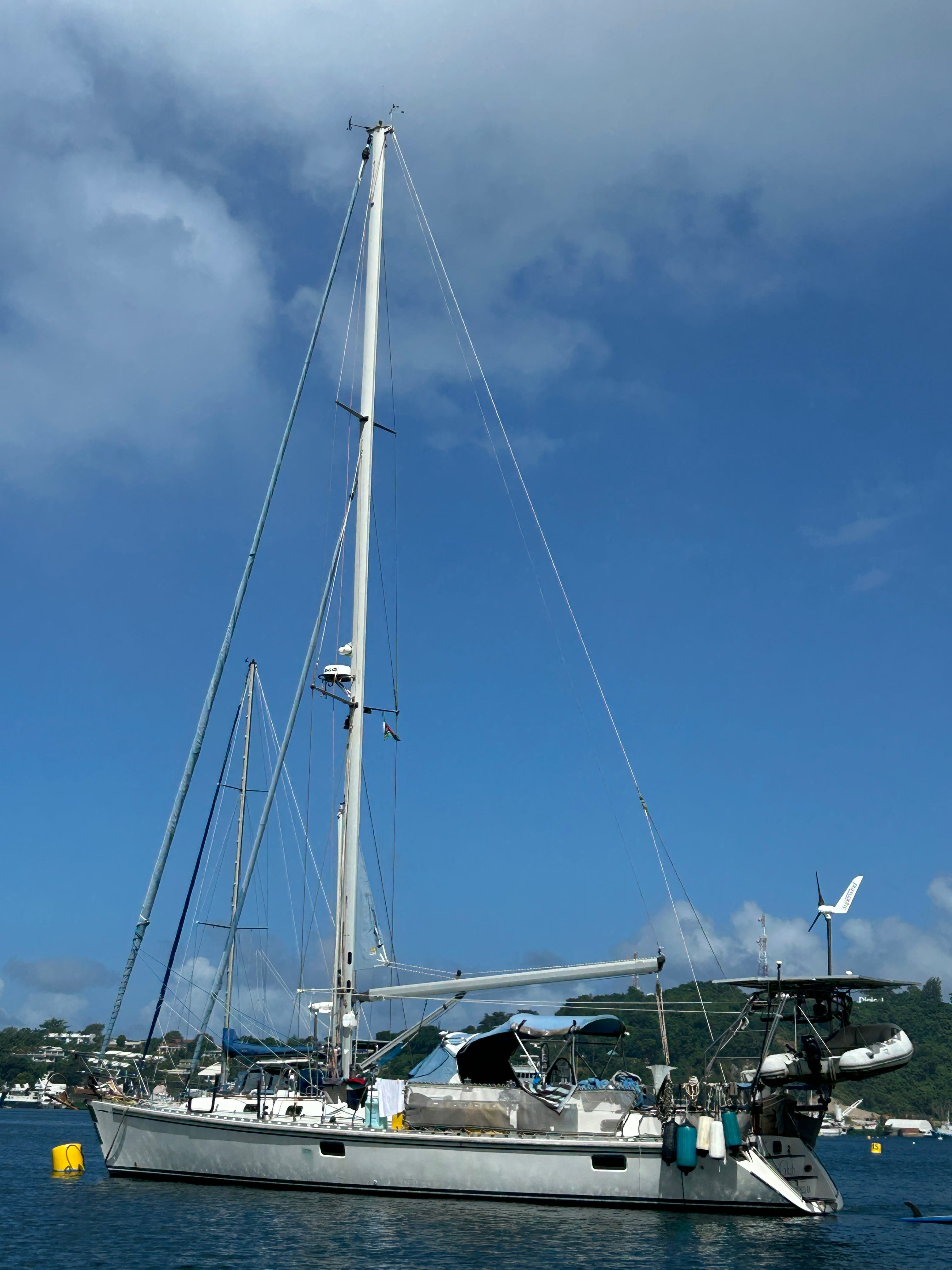
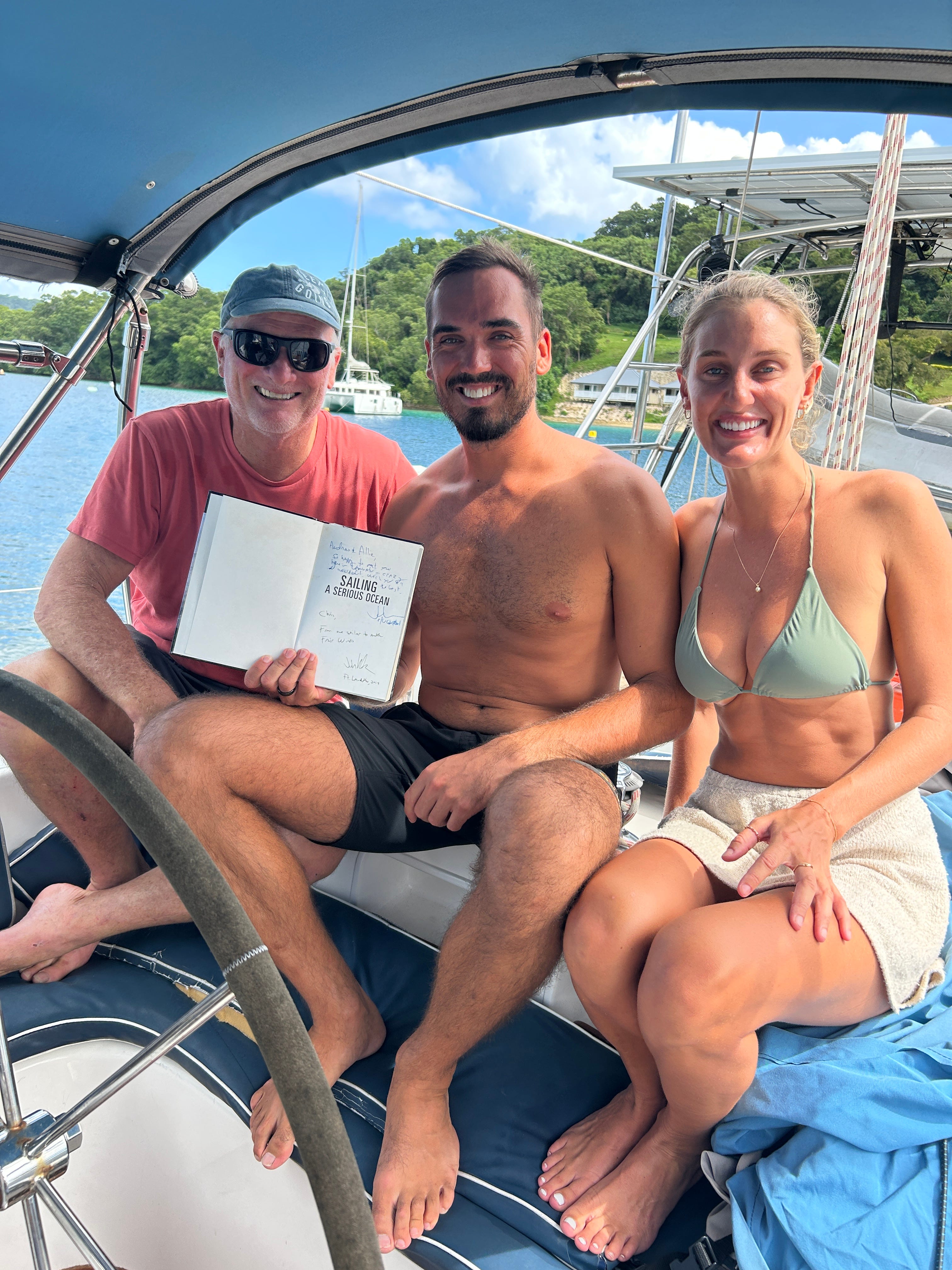
A few hours later I ran into the soon to be former owner, Chris, and the excited new owners, young Aussies Allie and Adrian. I had met Chris years before in Annapolis, after he bought the boat from the original owners and renamed her SeaGlub. He reminded me that the boat was first called Tempest. I delivered Tempest on her maiden voyage from Fort Lauderdale to St. Thomas in 1998. She certainly lived up to her name as a few days into the passage we were overrun by remnants of the super storm Hurricane Mitch. It’s a story that I’ve told in many seminars and talks on heavy weather strategies and wrote about in my book, Sailing a Serious Ocean. In the chapter, Storm Stories, when I list my top ten storm experiences, it comes in at number 3!
I was a hard working delivery skipper and sailing journalist 27 years ago and fortunate to be able to deliver almost every new Hylas that came down the ways. It surprises many to learn that most Hylas’, especially in the 80s and early 90s, began life as charter boats in the Virgin Islands. Almost all 44s and 47s were first bare-boats with CYC (Caribbean Yacht charters) and even as the designs evolved into the Hylas 46, 49 and 54, many did stints as charter boats before becoming private cruising yachts.
It was late October and Tempest was headed for St. Thomas. It was a route I knew well, having made the passage more than 30 times at that point. It’s also a route that’s easy to underestimate. It’s natural to assume you head south from Fort Lauderdale to the Caribbean but that’s not really the case. It’s a west to east affair. Fort Lauderdale is at 26°N, 80°W and St. Thomas is at 18°30’N, 65°W. For every degree you sail south you have to pound out two degrees east. The prevailing winds are easterlies and become stronger and steadier as you push south. In short it’s a slog, a tough 1,000 miles and I always earned my money.
My friend, the late Dick Jachney, was the owner of CYC, and the chief importer of Hylas yachts. He used to encourage the new owners to join me on the delivery. Dick was a consummate salesman, and that’s also putting things gently, and he’d tell them, “you will love sailing with John, and it’s a beautiful Caribbean sail.” He neglected to tell them that they’d only feel the pitch of the Caribbean on the last day of the passage and only after a week of bashing and crashing to windward. Keeping dreams intact after new owners had just spent several hundred grand only to be puking, feeling miserable, and ready to sell at any price, was good preparation for the training passage business. Full of smiles, new owners Bob and Susan joined me. My dear friend Ed also signed aboard as first mate and cook.
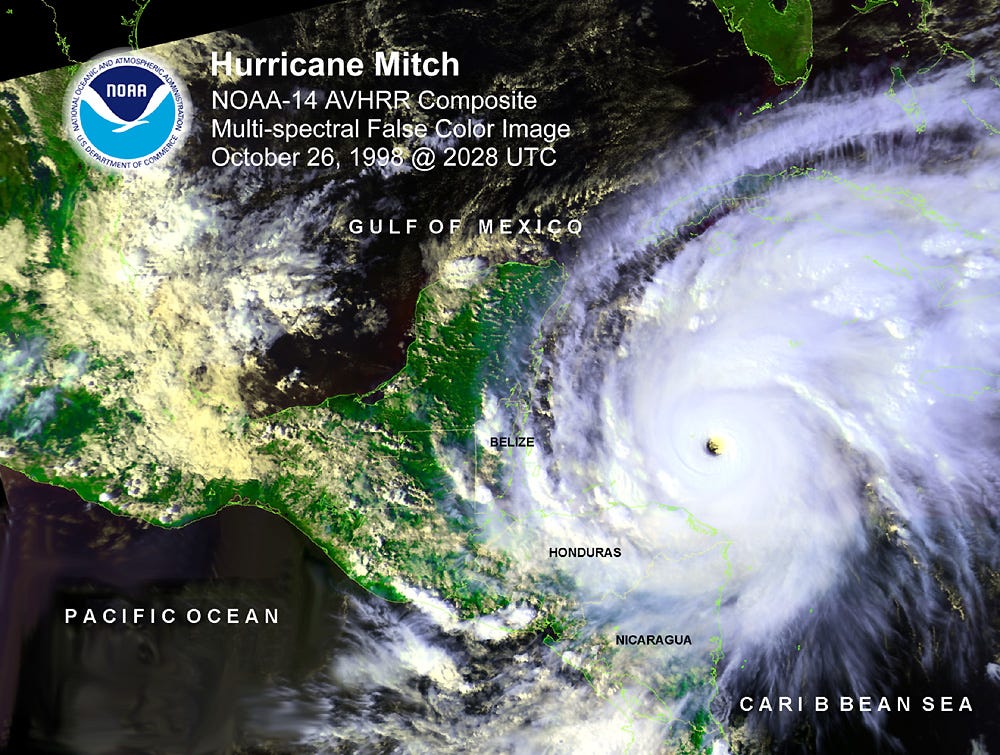
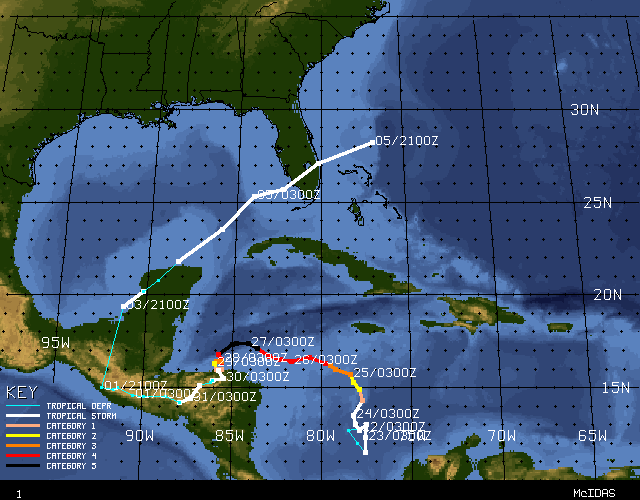
We shoved off on November 3, convinced that Hurricane Mitch was heading for the interior of Mexico, or at worst, the Texas coast. Mitch, a Cat Five monster with sustained winds of 155 knots and gusts over 200, killed more than 11,000 people in Central America. It was a mean spirited, horrible storm. Lumbering north toward the Yucatan Channel, Mitch finally began to fall apart. As the muddled mass of low pressure reached the Gulf of Mexico it was forecast to lose steam and drift toward Texas. It was the perfect time for us to depart.
We cleared Port Everglades, crossed the Gulf Stream and sped east for two days.
The brand new, Frers designed Hylas 46, sailed brilliantly but was very lightly equipped. She had a bimini top for shade but no spray dodger. She had an in-mast furled main and a 135% furling genoa. Her electronics consisted of a compass light, depthsounder, wind instrument and VHF radio. Bob and Susan planned to leave her in charter for a year, to defray costs, and then properly outfit her for cruising the Caribbean. There was no reason to let bareboat charters wear out new equipment.
Ed, our cook, was not doing well. He was down in the dumps after a recent car accident shattered his leg and longed for a blue water passage to lift his spirits. It was not my best decision to sign him aboard and unfortunately the motion of the boat, even with smooth sailing, was tough on him. He gamely hobbled around the galley churning out delicious meals. On day three we strapped into the settee berth as the weather started to turn.
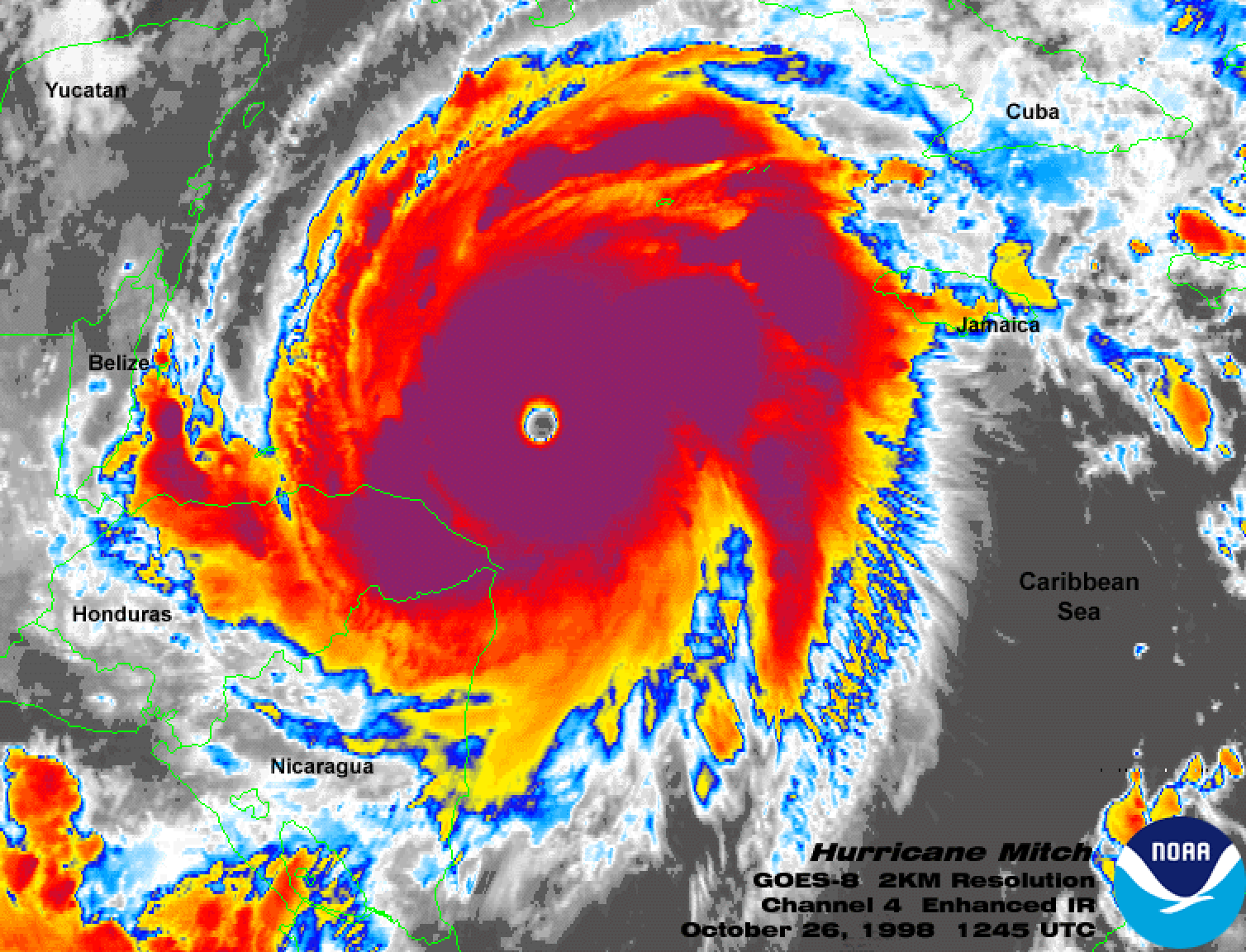
Instead of dissipating, Mitch regrouped and headed east toward the Florida Keys. The storm that 24 hours earlier had been downgraded to a tropical depression suddenly had 45 knot winds with gusts to 60 knots in a newly reorganized tropical storm. Mitch raced across the Florida peninsula. Fowey Rocks Light Station off Biscayne Bay recorded a 63 knot peak gust. Instead of tracking north, Mitch continued to confound forecasters by turning east-northeast toward the Bahamas and briefly regaining hurricane status. It was coming our way.
Once again waves were the wind’s messengers, and soon a pronounced swell rolled in from the south-southeast. By noon the winds were up to 25 to 30 knots from the south, and the trusty barometer on my Casio watch was falling fast. Things were getting interesting. We were flying east under a deeply furled main and headsail. The ride was becoming progressively worse as the seas were transformed into powerful ocean rollers.
In those pre Starlink, pre Iridium, pre weather model days, I tuned my shortwave receiver to the NOAA broadcast. In a scene right out of a cheap movie, just as the computerized voice of Perfect Paul announced, “Tropical Storm Mitch has reformed, and may be upgraded to hurricane tonight,” a wave washed aboard and silenced the radio for good. We later learned that the eye of the storm passed 50 miles north of us. Ironically, 7 years earlier, in about the same place, I rode out Hurricane Bob in a Hylas 44. Strangely, it never occurred to me to change careers?
By 1600 we had steady Force 9 conditions and stronger gusts. We could hear the storm winds winding up, preparing to blast us, it was eerie and somehow beautiful. We were pressing on with tiny sails, literally bath towels of main and jib, and the boat was handling the conditions well. She tracked true in very confused seas, a key design feature in heavy going. I was determined to make miles to the east while we could, it made no sense to turn back or seek shelter. As we pushed east the system, which was quickly becoming extra tropical, was charging to the northeast. Late-season hurricanes typically become extratropical when they move into more northerly latitudes over cold water. At this point they no longer suck their energy from warm tropical waters but instead from the horizontal temperature contrasts from frontal air masses. Their forward speed increases dramatically and is tacked on to the wind speed of the cyclone.
The wind was forward of the beam and the breaking seas were dangerous. We were hand steering and Bob and I took long stints at the wheel. There was no autopilot or self steering. Susan was not happy and after a nasty fall retired to the aft cabin. Ed was miserable. But Tempest was coping beautifully. The boat was rock solid and once again I felt that perverse privilege to have a court side seat for watching an angry ocean do its thing. I guess that’s a different kind of weather window.
The winds frequently pinned our instrument at 63 knots in gusts and backed to the SE. The seas continued to build, ultimately to 10 meters as we learned later. We were fore-reaching at that point, making 3-4 knots. At times I was underwater at the helm as waves washed over the boat. My biggest concern was chafe on both furling lines, a suddenly unveiled sail would have been disastrous. While we could have kept fore-reaching, we were too exhausted to keep steering and hove to. With the help of the engine we tacked between giant crests and backed the tiny headsail. The boat came to rest about 50° off the wind. Our crabbing to leeward created a slick that prevented most waves from breaking aboard.
The winds peaked around 2200. We learned afterward that several ships and yachts reported gusts over 70 knots. I will never forget sitting in the cockpit watching the wild sea surrounding us. The boat would ride up the face of a wave and slide harmlessly to leeward as the waves pressed under the keel. Mitch was moving fast, at 40 knots, which contributed to much of the wind speed. By midnight the worst was behind us. By 0200 the winds had backed all the way to the northeast and we were underway again, on course and making 7 knots slaloming through, around, and over confused seas. We made St. Thomas in just less than 7 days.
I confess, I had to reread the chapter in Serious Ocean ( and quote from it) and listen to my own webinar on heavy weather sailing to fully recall the details of that nasty day and night 27 years ago. There was also an addendum, about a nearby boat that was rolled over but I am going to save that story for the upcoming article on the strategy of fore-reaching in deep storms. It’s a sad lesson.
Sitting here in Port Vila, remembering that long ago storm, I am struck by the technological developments that have fundamentally changed the nature of offshore sailing. Looking over at SeaGlub, she’s now rigged as a cutter, has solar panels, a wind generator and all the gear necessary for happy cruising and living aboard. But gear aside, the real difference maker these days is access to accurate weather information.
Sailing a Serious Ocean was published in 2014. Of the top ten storms listed, 7 of them occurred before I bought Quetzal in 2003. And those that include Quetzal happened mostly in the early days. As much as I moan and groan about people’s obsession with weather models, and waiting for weather windows, it’s undeniable that GRIB files have made most offshore passages safer. While the long term climate is less predictable than ever, short term weather forecasts based on sophisticated models are incredibly accurate.
Since 2014, Quetzal and I have certainly encountered serious storms, the 2022 Bay of Biscay beating and the Drake Passage mugging in 2024 jump to mind. But we’ve also logged thousands of miles, well over 100,00 miles since then, and we’ve managed to mostly avoid deep ocean storms. Mostly is the key word. The more you sail the more likely you will encounter your storm and you will be tested, and it will be part of your story.
You can’t rely on avoidance alone, not if you plan to cross oceans, sooner or later the window closes, and sometimes it slams shut. But with instant and almost unlimited access to satellite weather data you can make informed decisions about when to shove off and, more importantly, what tactic to adopt at sea to minimize heavy weather. This is a luxury and an example of technology profoundly enhancing good seamanship. We likely would have avoided Mitch if I was doing the same delivery last year.
However, at some point you also have to come to an agreement with the ocean if you want to cruise successfully. Enjoying your time at sea, especially these days when the world can seem torn asunder, is also a privilege. Every passage does not need to be a mad dash between A and B. That’s too stressful and no fun. You are out there for the experience, for the stories, yours and your boat’s. ‘Time at sea is time well spent.’
SeaGlub formerly Tempest, has her own story. Bob and Susan did end up spending years cruising the Caribbean. Chris, her second owner, sailed her far and wide, south to Mexico and across the Pacific in 14 years of ownership. And who knows where Allie and Adrian will take her? The story is still being written, I hope they enjoy every minute of it.
John Kretschmer has been sailing professionally for 40 years, logging 400,000+ miles. He is the author of 7 books, including the international bestseller Sailing a Serious Ocean. John Kretschmer Sailing offers training passages, workshops, webinars and Captain’s Hour, a monthly meeting about all aspects of offshore sailing. For more information, email John at john@johnkretschmersailing.com
"The boat was rock solid and once again I felt that perverse privilege to have a court side seat for watching an angry ocean do its thing. I guess that’s a different kind of weather window."
"...a different kind of weather window"-- best metaphor inversion of the year. And isn't such a window only open to a boat with the right underbody, all else being equal? I know you covered this beautifully in your paean to the "The Roman Arch of Blue Water Sailing",--the skeg-hung rudder and deep, longish fin keel-- but how do you think its opposite would have fared in those conditions? It seems an unsupported semi-balanced spade and high-aspect keel would have made life for you guys a lot harder, especially hand-steering. And what about the current fashion for wide transomed, twin spade designs--with centerboards, no less?
I am in favor of being able to gaze with confidence out of the "weather window" of your coinage, not the one that reveals itself in the blue glow of a computer monitor. How do we get the industry back on course, making boats that track true and defend us against the attempted muggings of a serious ocean?
Nice to see Sailing a Serious Ocean get a great p;ug! Hope all is well...Molly